

An early sign of scleroderma can be Raynaud's syndrome, in which fingers and toes turn white under stress and cold. A Hamburg expert advises people to get a medical check-up if they have these symptoms.
Hamburg. Anni Jenett is 79 years old. But despite her old age, her face shows hardly any wrinkles. The reason: The old lady suffers from a rare rheumatic disease in which the skin thickens and hardens more and more until it finally envelops the body like a shell. But it took a long time until she was diagnosed with this disease. It all started seven years ago when she felt that her stockings were pressing on her legs. Then followed an odyssey from one specialist to the next, without anyone finding the cause of her symptoms. When the disease was finally diagnosed, her lungs were already affected.
Typical symptoms of scleroderma
"The disease is called scleroderma. A typical sign is an increase in connective tissue, not only in the skin. It can also occur in all internal organs and impair their function. In the joints, especially in the fingers, it leads to restricted movement, so that those affected can no longer move their fingers after a few years without adequate treatment," says Dr. Keihan Ahmadi-Simab, rheumatologist and founder of MEDIZINICUM Hamburg (Centre for Interdisciplinary Medicine).
The specialist has specialized in the treatment of scleroderma. Like his patient Anni Jenett, most people who suffer from the disease are affected: The disease is often only recognized when internal organs are already affected. "This is because the first symptoms, such as tiredness and fatigue, are very unspecific," says the rheumatologist. However, there is also a phenomenon that is generally regarded as harmless, but which can also conceal scleroderma. We are talking about Raynaud's syndrome. Typically, the blood vessels in the fingers and toes contract when exposed to cold or stress. As a result, the fingers initially turn white and then turn deep blue and red as the blood rushes back in. Young women are most frequently affected. "In some cases, Raynaud's syndrome is harmless, but in 80 percent of cases it is caused by a more serious disease, most commonly scleroderma. This is why people who have Raynaud's syndrome should always be examined by a rheumatologist," recommends Ahmadi-Simab.
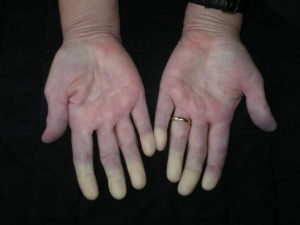
If there is a suspicion of scleroderma with Raynaud's syndrome, this can be clarified with simple examinations: "We can use capillary microscopy to detect typical changes in the nail bed and sonography to detect changes in the walls of the blood vessels. Special blood tests provide further clues," says the rheumatologist.
Therapy for scleroderma
Although scleroderma cannot be cured, early treatment can slow down the progression of this autoimmune disease and delay the pathological growth of connective tissue in the organs. "We have made great progress in treatment over the past five years. Even if we still cannot identify the cause, we now have drugs that can positively influence the disease process," says Ahmadi-Simab.
It is now known that the messenger substance endothelin plays a key role in this disease. "This is a messenger substance in the body that is found in the inner lining of blood vessels and in the skin. There are usually two receptors for endothelin that are in balance with each other. For whatever reason, scleroderma leads to a derailment of the endothelin system, resulting in an excess of this messenger substance. This leads to inflammation, thickening and narrowing of the blood vessels. And it is this narrowing of the blood vessels that ultimately leads to death," says Ahmadi-Simab.
It becomes particularly threatening when the pulmonary artery is narrowed and pulmonary hypertension develops. The result is that the blood supply to the lungs becomes increasingly poor and less oxygen can be absorbed. In addition, the increased pressure in the artery increasingly overloads the right ventricle, which can eventually lead to heart failure.
Now there are drugs that counteract the excess endothelin. They are approved for use in cases where severe complications, such as pulmonary hypertension, have already occurred and can significantly delay the onset of the disease.
In early stages infusions with prostaglandins can also be given. They dilate the blood vessels and can also delay the thickening of the skin. Patients who constantly receive these infusions rarely experience changes in their internal organs.
The third option for dilating the blood vessels is sildenafil, which has become known as Viagra for the treatment of erectile dysfunction and is now also approved for the treatment of complications of scleroderma. "Thanks to the new drugs, the proportion of patients suffering from pulmonary hypertension as a result of scleroderma who are still alive after five years has risen from 30 to almost 80 percent," says Keihan Ahmadi-Simab.
Studies have shown that the active substance imatinib, which is also used to treat cancer, can be used successfully in the early stages of the disease. Stem cell transplantation also showed first positive results.
Anni Jenett is certainly satisfied with her treatment at the Asklepios Clinic Altona. Thanks to the medication she receives here, she can now fully move her fingers again, which had become increasingly stiff and immobile in the weeks before her hospital stay. Her pulmonary fibrosis, however, can no longer be eliminated by the medication. At some point, it will be so advanced that Ms. Jenett will also need oxygen therapy. But at the moment she is still very mobile: "I still walk up and down the stairs, I have to be able to do that."
For more information on the subject of SKLERODERMIE, please visit: sklerodermiezentrum.de


